

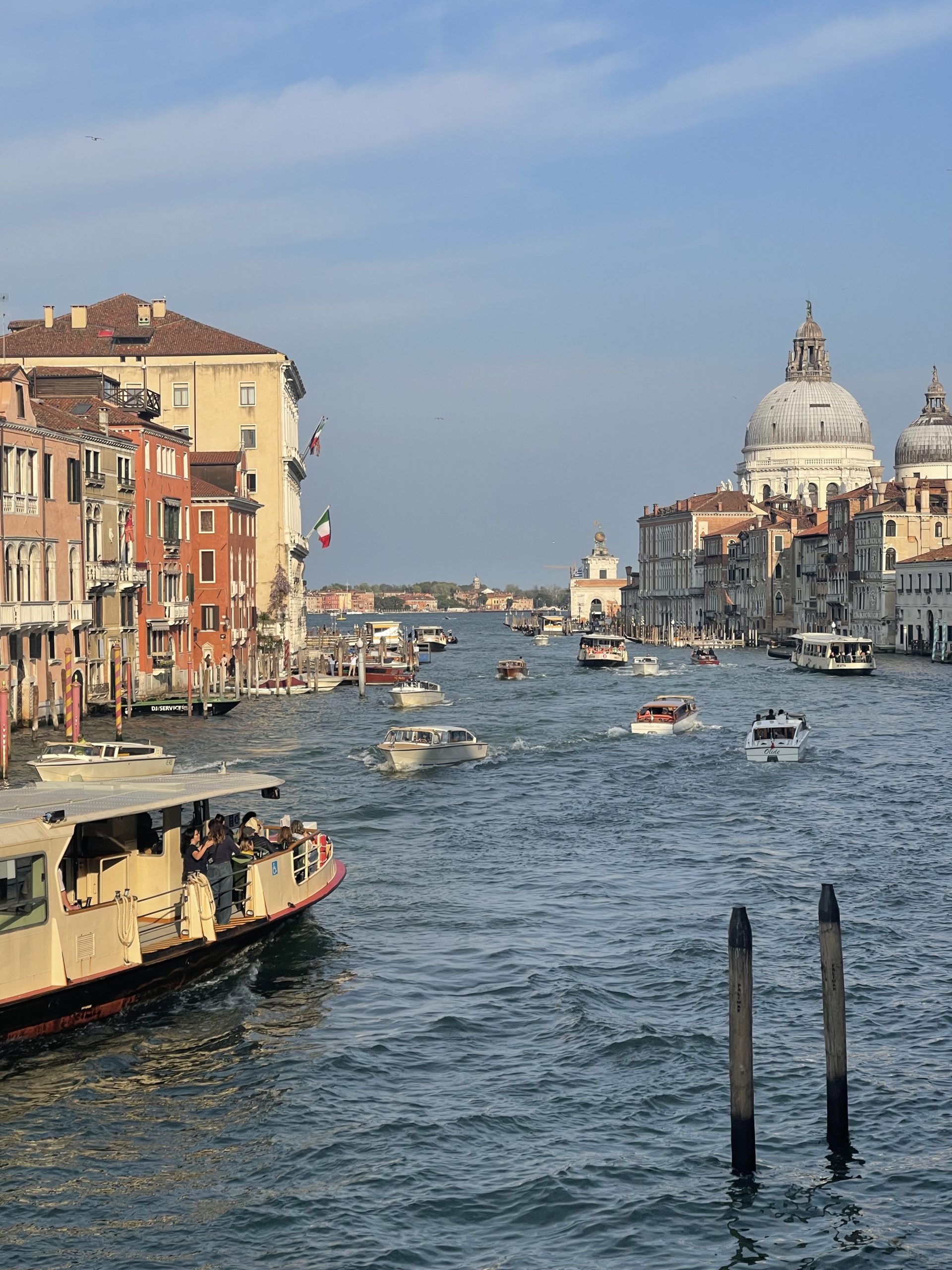
Venice is one of those places that really does feel unreal the first time you see it. A city built entirely on water, with canals instead of roads and boats instead of cars, it’s a maze of narrow alleys, bridges, church towers and hidden squares. It sits in a lagoon in northeastern Italy and is made up of more than 100 small islands connected by over 400 bridges. The historic center is compact, entirely walkable, and unlike anywhere else in the world.
The first thing to know about Venice is that getting around is different. There are no cars or bikes in the historic centre, so you’ll walk or travel by boat. Public “vaporetto” waterbuses run along the Grand Canal and around the lagoon, and they’re the most practical way to cover longer distances. Gondolas are iconic, but they’re mainly a scenic, and expensive, experience rather than transportation. Expect to get lost at least once; in Venice, that’s part of the charm, and you often stumble onto quiet canals and beautiful little campos when you do.
Timing matters in Venice. The city can be very crowded during summer and major holidays, while spring and early autumn usually offer pleasant weather without peak-season intensity. Winter is colder and quieter, often atmospheric with misty mornings and the famous Carnival in February. Water levels can rise at certain times of year, causing “acqua alta” (seasonal flooding), when raised walkways are installed and parts of the city become temporarily wet underfoot. Visiting slightly off-season is often more comfortable and more rewarding.
Venice’s biggest attractions are famous for a reason. St Mark’s Square, St Mark’s Basilica, the Doge’s Palace, and the Rialto Bridge are essential sights for first-time visitors. But the real magic often lies beyond them, in neighborhoods like Dorsoduro and Cannaregio, where daily life feels more local. A trip out across the lagoon to islands such as Murano (glassmaking), Burano (colorful houses and lace), and Torcello (ancient cathedral) adds another layer to understanding the city’s history and craft traditions.
Accommodation in Venice ranges from historic palazzi turned into luxury hotels to small guesthouses tucked down quiet alleys. Staying in the historic center means you’re close to everything, but prices are higher; areas just outside, like Mestre on the mainland, are cheaper but require commuting in. Wherever you stay, pack light. You’ll probably be carrying your luggage over bridges and cobblestones, and sometimes through crowds.
Food in Venice has its own lagoon-influenced character. Expect seafood, cicchetti (Venetian tapas-style bites served in bacari wine bars), fresh pasta, and simple but delicious desserts. Stray a street or two away from the busiest tourist routes and you’ll often find better value and more authentic menus. As with any popular city, check for service charges and avoid restaurants aggressively advertising to passersby in crowded squares.
Because Venice is fragile, responsible travel really matters. The city faces challenges from over-tourism, cruise traffic, and rising sea levels. You can help by staying longer rather than visiting just for a few hours, supporting local businesses, refilling a reusable bottle instead of buying plastic water, respecting residential areas, and following rules about sitting, swimming, or picnicking in restricted places. Be mindful that Venetians actually live here; keep noise down at night and avoid blocking narrow streets or bridges.
Practical tips make a big difference. Comfortable walking shoes are essential, as are layers for changeable weather. ATMs are easy to find, but some small cafés still prefer cash. Learn a few basic Italian phrases, “grazie,” “per favore,” “scusi”, which go a long way in a city proud of its heritage. Keep an eye on canal edges and steps, especially when it’s wet; Venice is beautiful, but it can be slippery.
What you really need to know about Venice is this: it rewards curiosity and slowness. If you rush from sight to sight, you’ll see the postcard version. If you wander early in the morning or late at night, listen to church bells echoing over the water, watch laundry blowing between buildings, and cross quiet bridges with no one else in sight, you’ll understand why so many people fall in love with it. Venice isn’t just a place to tick off a list—it’s a mood, a rhythm, and an experience unlike anywhere else on earth.