

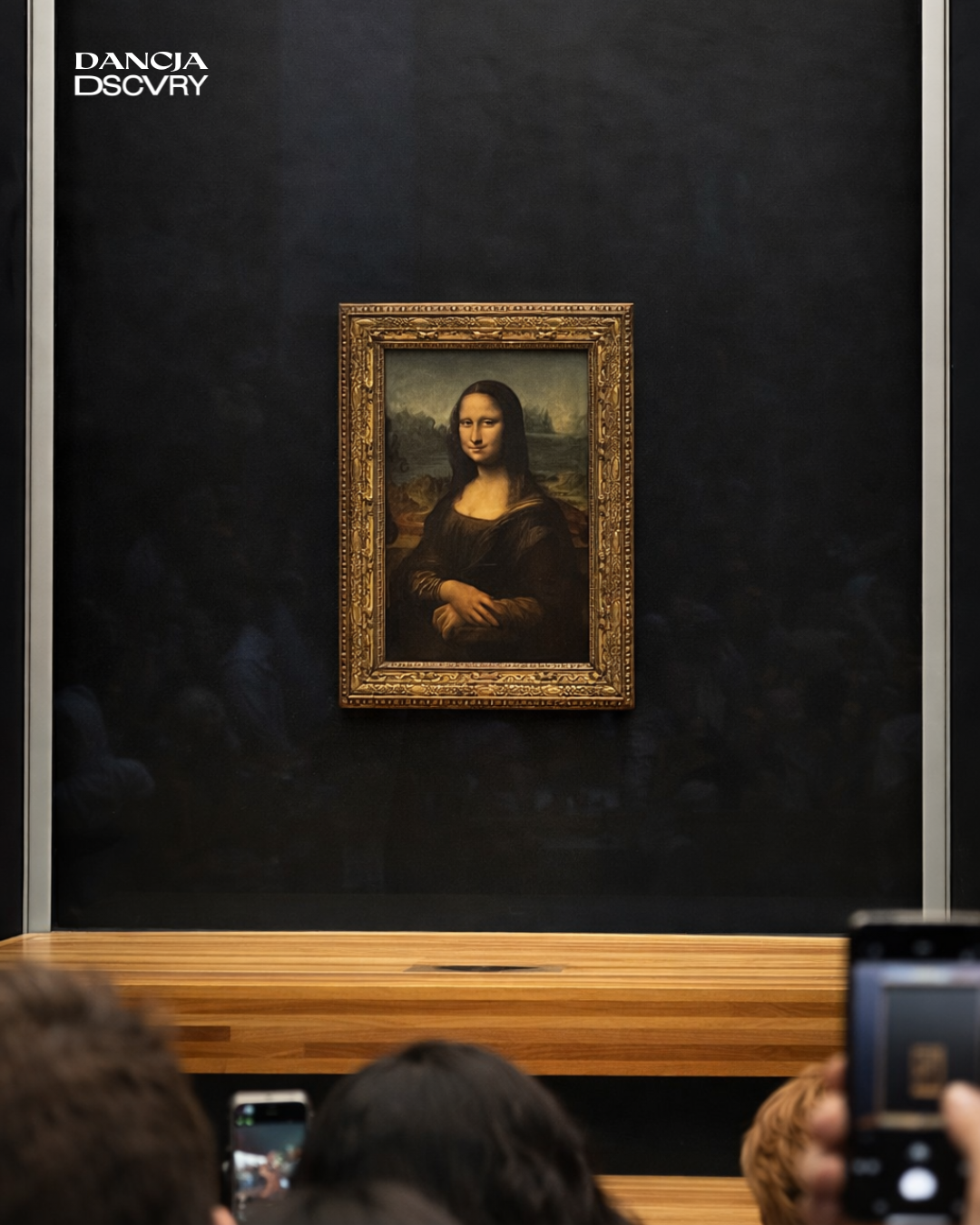
You have seen her a thousand times. On mugs, T shirts, memes, textbooks, parodies, and posters. Yet standing in front of the real Mona Lisa in the Louvre is oddly shocking. She is smaller than you expect. Quieter than you expect. And far more mysterious than you ever imagined.
Painted by Leonardo da Vinci over 500 years ago, the Mona Lisa is not just a portrait. It is a puzzle, a scientific experiment, a stolen treasure, and one of the greatest marketing accidents in art history.
Here are fascinating facts about the world’s most famous painting that most people never hear.
Her real name is not Mona Lisa
“Mona” is not a first name. It comes from “Monna,” a polite Italian way of saying “Madam.” Her name was Lisa Gherardini, the wife of a Florentine silk merchant named Francesco del Giocondo. That is why the painting is also known in Italy as La Gioconda. In France it is called La Joconde.
So the most famous woman in art history is actually Madam Lisa.
Leonardo never delivered the painting
Leonardo da Vinci was commissioned to paint Lisa’s portrait around 1503. He worked on it for years and then simply… never gave it to the family. He kept it with him for the rest of his life, carrying it from Italy to France when he moved there under the invitation of King Francis I.
Historians believe Leonardo considered it a personal experiment and kept refining it. It was not a finished job to him. It was a lifelong project.
The smile is a scientific illusion
Her smile is not painted in a clear, defined way. Leonardo used a technique called sfumato, which means soft, smoky blending. There are no hard lines around her mouth. Because of this, your eyes interpret her expression differently depending on where you look.
If you stare at her mouth, the smile fades. If you look at her eyes, the smile appears stronger. Your own vision completes the expression. In a way, you create her smile in your brain.
This is why people argue about whether she looks happy, sad, amused, or secretive.
Her eyebrows are missing for a reason
Many people think Leonardo forgot to paint her eyebrows. He did not. High resolution scans show faint traces of eyebrows that have faded over centuries due to cleaning and aging varnish.
In Leonardo’s time, women often plucked their eyebrows and hairlines as a fashion statement. So even if they were more visible, they would have been very thin.
The background is imaginary
The landscape behind her is not a real place. It is a dreamlike combination of winding roads, strange mountains, and rivers that do not exist together anywhere in Italy.
Even stranger, the horizon line is uneven. One side sits higher than the other. This subtle trick makes her appear more dominant and alive in the composition.
The painting is surprisingly small
In person, the Mona Lisa is only about 77 centimeters tall and 53 centimeters wide. Roughly the size of a laptop screen. Visitors expect a giant masterpiece. Instead they find a modest wooden panel behind thick glass, surrounded by crowds.
Her fame has grown far larger than her physical size.
It was once stolen and that made it world famous
For centuries, the Mona Lisa was respected but not legendary. That changed in 1911.
A museum worker named Vincenzo Peruggia hid in a broom closet overnight, walked out with the painting under his coat, and kept it in his apartment for two years. He believed it should be returned to Italy.
The theft made international headlines. Newspapers around the world printed her image. Suddenly everyone knew her face. When she was recovered, she was no longer just a painting. She was a celebrity.
Ironically, being stolen made her the most famous artwork in the world.
Napoleon kept her in his bedroom
Before the Louvre became a museum, Napoleon Bonaparte took the Mona Lisa from the gallery and hung it in his private bedroom in the Tuileries Palace for several years. He simply liked it and wanted it close.
The most famous painting in history once served as bedroom decor.
She is painted on wood, not canvas
The Mona Lisa is painted on a poplar wood panel, not canvas. This was common in Renaissance Italy but unusual for such a delicate work to survive this long. The wood has warped slightly over time and requires careful climate control.
This is one reason she is kept behind protective glass in a temperature controlled case.
She has been attacked several times
Over the years, people have thrown stones, acid, and even a mug at the Mona Lisa. In 1956, a man threw a rock that chipped some paint near her elbow. This damage is still there today.
These incidents are why she is now protected by bulletproof glass.
Leonardo may have painted himself into her
Some art historians believe the Mona Lisa contains subtle features of Leonardo’s own face. When his self portraits are compared with her proportions, there are similarities in the nose, eyes, and facial structure.
The theory is that he blended his own likeness into hers as part of his fascination with human anatomy and identity.
She has no clear eyelashes
Like the eyebrows, her eyelashes are barely visible. This was partly fashion and partly Leonardo’s subtle painting technique. He avoided harsh lines, which adds to the softness and realism of her face.
She has inspired more parodies than any artwork in history
From Salvador Dalí to Marcel Duchamp to modern memes, the Mona Lisa is the most parodied artwork ever created. Duchamp famously drew a mustache on a reproduction in 1919. That single act helped launch modern conceptual art.
She is not just a painting. She is a cultural icon that artists continue to play with.
Why people cannot stop looking at her
There is no jewelry. No dramatic pose. No bright colors. No action. Just a woman sitting quietly.
Yet her gaze seems to follow you. Her expression seems to change. The background feels otherworldly. Leonardo used anatomy, psychology, optics, and patience to create something that feels alive.
You do not just look at the Mona Lisa. You interact with her.
And that is the real mystery.
Five hundred years later, the world is still trying to figure out what she is thinking.